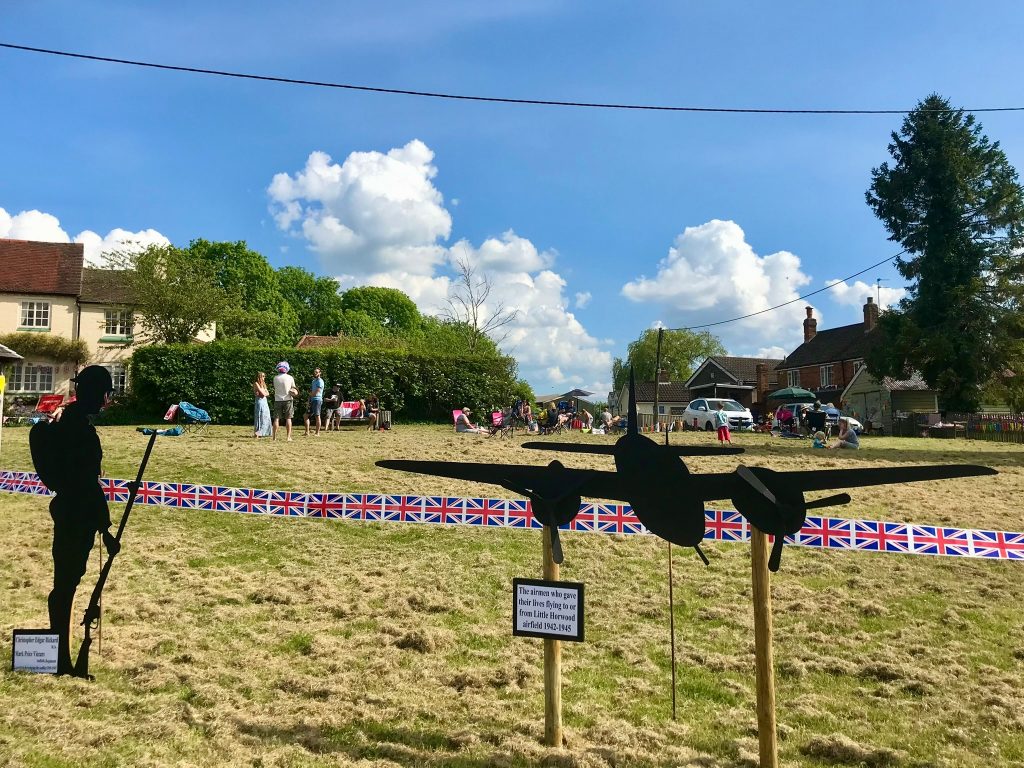
For a small village, there certainly was a lot going on in Little Horwood during the war years and due to its close proximity to Bletchley Park, GCHQ’s Whaddon Hall and Hanslope Park, it’s hardly surprising. A special thank you and acknowledgement goes to Terry Smith for the information in this section which came from his book containing his memories and collection of villagers’ wartime oral histories.
Perhaps one of the most interesting theories is surrounding the reason for the building of Little Horwood Manor which was at the centre of the wartime activity. Legend has it that entrepreneur George Gee had a £1,000 bet with an aristocrat likely to be Lord Rosebury or Lord Rothschild that he could build and move into a manor house in record time. However, emerging evidence suggests that this wager could all have been subterfuge….
As a successful entrepreneur and owner of a large London building firm with wealth, connections and huge resources to draw on, Gee rented The White House on the Winslow Road for the 1937-8 winter hunting season and during this period bought Manor Farm in the village. His wager (or perhaps cover story) was that he could build and move into a new manor house by the opening meet of the Whaddon Chase foxhounds on the first Tuesday of November 1938.
Building work commenced in March 1938 and in a short amount of time, Gee bought up many different farms around the manor and in the village – put together forming a huge 1,000 acre estate. Although the manor wasn’t completely finished by October, Gee had moved in and won his “bet”. However the army requisitioned that majority of the manor estate in 1939 and it gets interesting …
Early in 1938, Admiral Sir Hugh Sinclair head of M16 purchased Bletchley Park and the famous subterfuge of “Captain Ridley’s shooting party” visited in September of that year where he, along with Commander Hugh Dennison from the Government Code and Cypher School (GC&CS) in the Foreign Office, led a group to secretly prepare the beginnings of the covert intelligence base at Bletchley Park. Terry Smith’s theory was that Gee’s “Whaddon Chase hunting party’ and the wager he made for the speedy build was actually cover for the building of Horwood Manor, not only an outpost of Bletchley Park, but a back-up building.
Terry’s discovered from an ex-resident that there was a huge electricity pipe feed going into Manor Farm (which was the war time officers quarters). He was told by an ex-electrician at Bletchley Park that it had been installed in case anything happened to Bletchley Park, they could move the Bombe machines to the manor and have an instant huge electrical supply to power them. Had Bletchley Park been bombed or compromised and this recollection is true, Little Horwood manor’s role in the war effort could have been even greater!
During the war, the manor and surrounding farms and fields was a hive of activity, with a busy training camp for Special Liaison Units to support Special Communications Units. Nissen and Laing huts were built to house Italian prisoners of war. Allied soldiers including Americans and Canadians were also billeted there or in houses around the village and a villager Ted Bull recalled how “the fields were alive with camped men”. Land girls were brought in to tend the fields and livestock and the pub repeatedly sold out of beer due to all the thirsty soldiers and airmen.
The four-man homeguard was on duty every night from dusk til dawn working four hours on, four hours off with two who patrolled the perimeter of the parish on foot while two remained at the guard house at the manor. They had quite a walk on their hands which took the full four hours, from the manor through the village to the White House on the Winslow Road, back to the village, up to Swanbourne station bridge, down to Whaddon crossroads, along the Buckingham road to the Nash crossroads and back to the manor. All roads in and out of the village had roadblocks and every car was stopped.
Not far from the manor, there was a building where radio sets were made for Secret Operations Executives’ (SOE) wireless operators in occupied territory. The mission of the SOE, often called Churchill’s secret army or the Ministry of Ungentlemanly Warfare was espionage, sabotage, and reconnaissance in enemy-occupied territory as well as aiding local resistance movements. Radio sets were large and cumbersome and often ‘disguised’ as suitcases, and operators had to avoid being tracked by German radio-location equipment, which could pinpoint a transmission in about 30 minutes. Their work was extremely risky, stressful and isolated and, if captured, they faced torture for information. With a life expectancy of just six weeks in the field, they were sometimes nicknamed “the Pianists” because of the constant and dangerous typing on the morse keys. It is sobering to think that brave SOE wireless operators such as the wartime heroine Noor Inayat Khan could have been using a set made in Little Horwood to relay vital intelligence back to England.
In his book, Terry Smith’s collection of war time memories from villagers really gives a vivid picture of the village being a noisy, busy and bustling place ‘full of blue and brown clad figures’, a huge influx of soldiers after Dunkirk and preparations for D Day ‘on a vast scale’ where ‘endless streams of tanks chugged by’. He even provides recollections of a trackless tank on its side in the brook and an armoured car with its engine alight on the green.
The village was also home to RAF Little Horwood on the Winslow Road which began construction in 1940 and was fully operational by 1942. It served primarily as a satellite airfield for RAF Wing and was used for bomber crew training. The airfield featured three concrete runways, made from rubble brought from bomb-damaged London, several hangars, and dispersed accommodation largely in Great Horwood for aircrew and support staff, including members of the Women’s Auxiliary Air Force (WAAF).
Its main occupant was No. 26 Operational Training Unit (OTU), which trained aircrews on Vickers Wellington bombers, preparing them for operational service in Bomber Command. The unit also carried out “Nickelling” missions — leaflet-dropping flights over occupied Europe — as part of morale and propaganda operations. In 1943, No. 1684 Bomber Defence Training Flight arrived, using aircraft such as Curtiss Tomahawks to provide air combat training for bomber crews. Towards the end of the war it was used as a reception station for repatriated prisoners of war.
Terry Smith remembers the near constant noise and ‘banging and spluttering of engines’ of very low flying aircraft over the village as they practiced manoeuvres where they were so close, the crew could be seen waving. Tragically, several crashes occurred where airmen from RAF Little Horwood were killed. One behind the Church Street cottages, a second into the Mursley water tower in thick fog and a third in Winslow where not only were 4 crew killed, but also 13 civilians. A Polish bomber exploded over the village and many German planes crossed over Little Horwood with a series of bombs being dropped in a line from the manor to Narbury Wood.
RAF Little Horwood remained active until late 1945, after which it was decommissioned and returned to agriculture and today little remains of the wartime site.
It’s hard to imagine the now quiet and peaceful village of Little Horwood as a busy and noisy place full to the brim of people, both military and civilian going about their important daily tasks. Each playing their part in the war effort that would ultimately help secure allied victory.