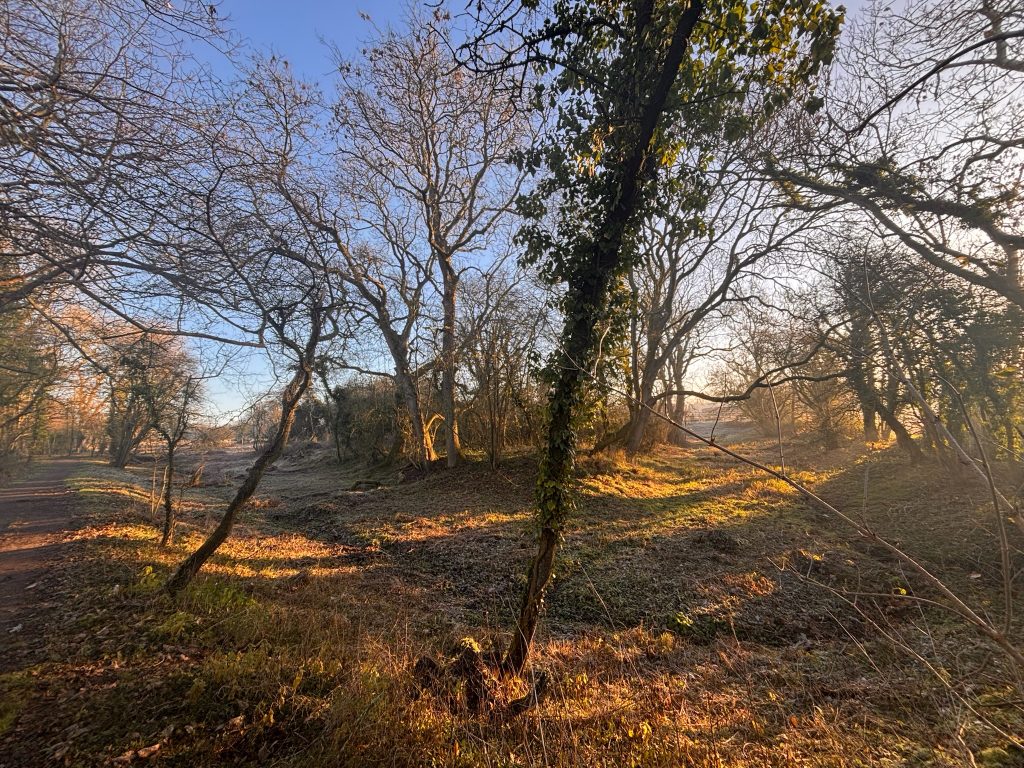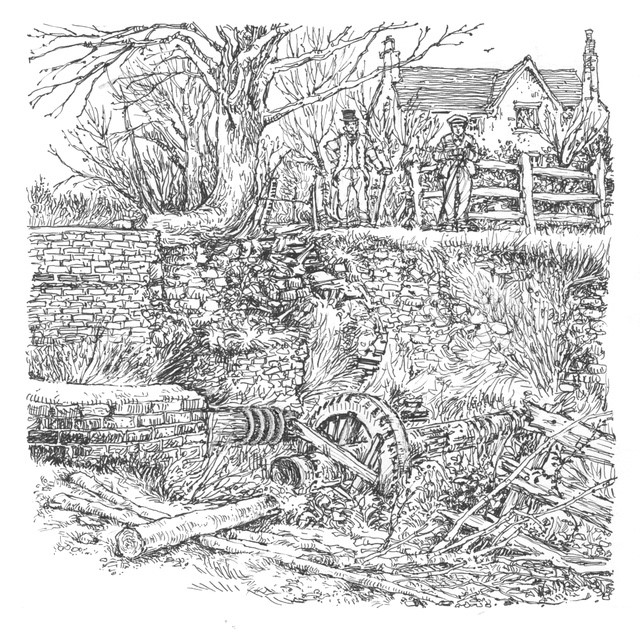
The Spinney is a beautiful and carefully managed area of woodland in the village that was acquired by the Parish Council in 2004. If it was possible to time travel back several hundred years, it would look very different and was a site of great importance to the village. A moated island measuring 44 metres by 52 metres, now an ancient monument site, has a long history of human habitation but all that is possible to be seen today is the rectangular moat and the causeway to the island. Nature has reclaimed the island and it is now a dense woodland and a haven for wildlife.
Archaeological evidence points to a medieval manor house once standing on the island where the village’s Lord of the Manor could have lived. Although it’s not possible to put a firm date on when it would have been built, these types of sites were popular in England between 1250 and 1350. People would create a moated island and build their house and outbuildings on it but it’s much debated by historians as to whether this was for security and defence or just a fashion for showing off wealth and status.
Records dating from the 13th century document who owned the manor of Little Horwood, which we are assuming could have included residing in the house on the moated island. In the 13th and 14th centuries these include the Aynels, the Fitz Niels, the le Newmans and the atte Asshes. By the 15th, 16th and 17th centuries the Cooks, Williotts and Granges are recorded.
In 1968 members of the Buckinghamshire Archaeological Society dug a series of test holes and found evidence of at least three different levels of construction, the lowest being medieval as well as pottery dating to 1100.
It is likely, therefore, that the medieval manor was replaced by a later house that became what was known as “Moat Farm.” In 1861 antiquarian J.J Sheahan quoted “a short distance eastward from the church is a decayed mansion, now the farm residence of the Moat Farm.”
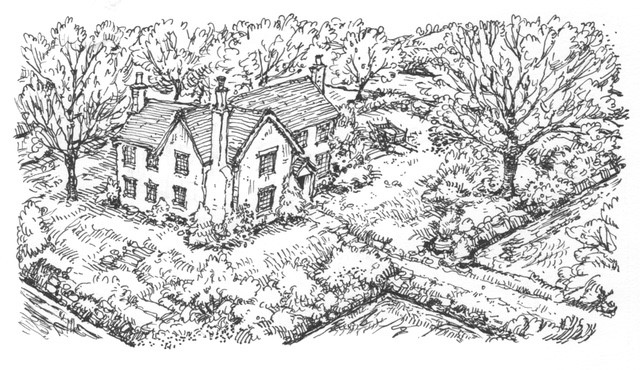
By using various census records and newspaper articles we can try and piece information together to suggest what became of Moat Farm, who lived there and when it became uninhabited.
A farmer by the name of Thomas Leeson appears in the 1841 & 1851 censuses and we assume he lived at Moat Farm as no address was recorded. We can assume this as, by the 1861 census, the record shows his family as living there and that it was 300 acres where he employed eight men and boys. In the 1851 census it was recorded as being a very similar 250 acres and he also employed eight men and boys. By the 1871 census he is recorded as living at Manor House which was 230 acres and he still employed eight men and boys.
A theory is that due to the dilapidated state of the original Moat Farm house on the moated island, a replacement farm house was built nearby as we can see from various censuses that the address of Moat Farm continued to be used for another 40 years. We know that nearby Manor Farm was built in 1870 by William Selby Lownes so it could well be assumed that Leeson moved into the new house with his family when it was first built and the house on the moated island then fell into disuse. However the names Manor House and Moat Farm continued to be used interchangeably.
So if Leeson was the last inhabitant of the house on the moated island, what happened to him? According to an article in the Buckingham Express on 30th November 1872, animals including 33 sheep, 14 cows, 6 cart horses, a pony, sow and pigs, 9 tonnes of hay, 4 wagons, 4 carts, dairy and farm equipment were to be auctioned on 5th December of that year. It details that the sale was directed by Thomas Leeson of Moat Farm who was “under notice to quit the farm by lady day next”.